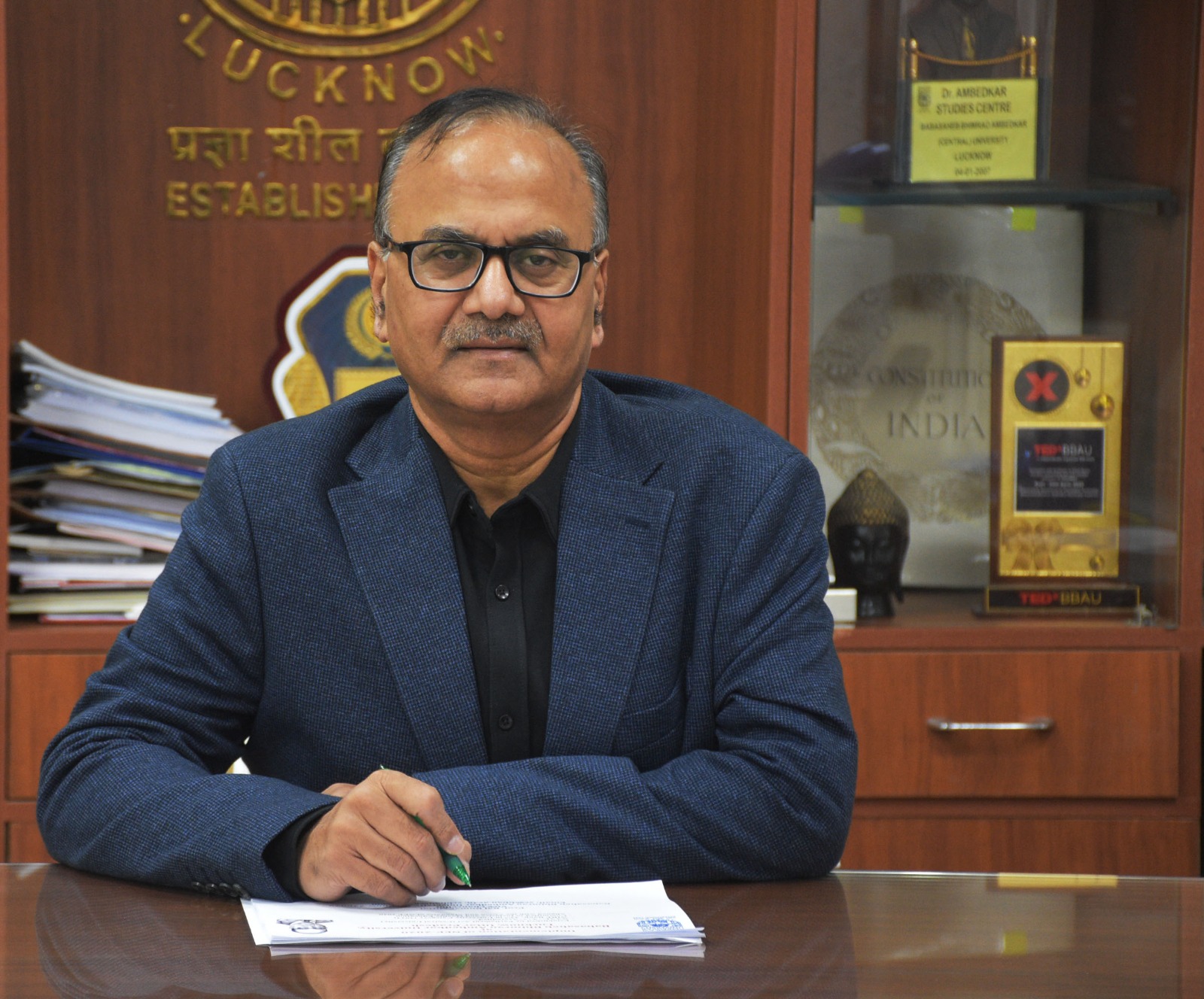
Lucknow: Babasaheb Bhimrao Ambedkar University is actively undertaking extensive initiatives to integrate the Sustainable Development Goals (SDGs) into its institutional framework, academic activities, research, innovation, social outreach and administrative policies. Under the leadership and guidance of Vice Chancellor Prof. Raj Kumar Mittal, the university considers SDG participation not merely a formal process, but a strong commitment toward social responsibility, institutional transparency, global competitiveness and sustainable development.
Vice Chancellor Prof. Raj Kumar Mittal stated that the university’s journey toward Sustainable Development Goals is not just a strategic priority, but also a reflection of its core values of social justice, environmental responsibility and inclusive progress. Through education, research and community engagement, the university is committed to nurturing future leaders who can drive sustainable transformation from local to global levels. The university aims not only to educate students, but also to develop them into socially responsible, environmentally conscious and sensitive citizens.
The university believes that higher educational institutions are not merely centres for awarding degrees, but are catalysts for social transformation, policy development, knowledge creation and sustainable progress. Keeping this vision in mind, the university has designed its teaching, research and extension activities in alignment with the Sustainable Development Goals. Various departments are conducting activities focused on education, health, nutrition, environmental conservation, water preservation, clean energy, gender equality, social justice, entrepreneurship, rural development and innovation.
Chairperson of the SDG Committee, Prof. Naveen Kumar Arora, informed that the university has prepared a long-term and systematic action plan for the implementation of Sustainable Development Goals. Under this plan, SDGs have been assigned to departments according to their disciplines and expertise. Faculty members in each department have been designated as SDG Coordinators to supervise and conduct departmental activities. To ensure active student participation, one male and one female student from each department have also been appointed as “Sustainable Ambassadors” to spread awareness about SDGs and take leadership roles in related activities while promoting gender equality. He further informed that the university is offering SDG-related courses through MPDC to develop foundational understanding and practical awareness among students. Additionally, efforts are being made to introduce an SDG Literacy Module for first-year students so that they can understand the concept of sustainable development from the beginning of their academic journey. The university is systematically mapping its undergraduate and postgraduate curricula with Sustainable Development Goals and their indicators. The curriculum prominently includes themes related to No Poverty (SDG-1), Zero Hunger and Nutrition Security (SDG-2), Good Health and Well-being (SDG-3), Quality Education (SDG-4), Gender Equality (SDG-5), Clean Water and Sanitation (SDG-6), Affordable and Clean Energy (SDG-7), Decent Work and Economic Growth (SDG-8), Industry, Innovation and Infrastructure (SDG-9), Reduced Inequalities (SDG-10), Sustainable Cities and Communities (SDG-11), Responsible Consumption and Production (SDG-12), Climate Action (SDG-13), Life on Land and Biodiversity Conservation (SDG-15), and Peace, Justice and Strong Institutions (SDG-16). The university is also aligning Course Outcomes and Programme Outcomes with SDGs through the Outcome-Based Education system.
The university is promoting interdisciplinary and experiential learning methods, including field visits, community projects, case studies, problem-based learning, water management surveys, health awareness campaigns and agriculture-based training programmes. Simultaneously, skill development, entrepreneurship and employment-oriented education are being encouraged to make students, especially those from economically and socially disadvantaged backgrounds, self-reliant.
In the field of research and innovation, the university is encouraging research on poverty alleviation, sustainable agriculture, climate change, water conservation, food security, public health, biotechnology, clean energy, waste management and social inclusion. Through its incubation and innovation centres, the university is promoting startup culture focusing on solar energy, biofuel, water purification, wastewater treatment, climate-smart agriculture, smart city solutions and environmental technologies.
Adopting a “Lab to Land” approach, the university is connecting research with society. Training, awareness and capacity-building programmes are being conducted for farmers, rural youth, women and marginalized communities. Initiatives such as Farmer Producer Organizations, value addition of agricultural products, market linkage support, nutrition and health awareness, legal awareness camps and community libraries are accelerating the development of rural and semi-urban areas.

To promote environmental conservation and green development on campus, the university is implementing systems such as rainwater harvesting, water recycling, energy efficiency measures, solar energy utilization, solid waste management, a plastic-free campus, green infrastructure and circular economy-based practices. Continuous efforts are being made to develop the campus into a green and climate-resilient campus.
To enhance awareness regarding Sustainable Development Goals, the university regularly organizes special lectures, student interaction programmes, poster competitions, rangoli competitions, quizzes, debates, plantation drives, cleanliness campaigns, nutrition-related programmes, women empowerment activities and community service initiatives. In accordance with the National Education Policy (NEP-2020), the university is also promoting multidisciplinary education, flexible learning systems and an inclusive academic environment.
The university administration is also working toward establishing a structured mechanism of departmental coordinators and student ambassadors for effective implementation and monitoring of SDGs. Plans are underway to develop KPI-based monitoring systems, digital dashboards and data-driven evaluation mechanisms at the departmental level.
As part of its future roadmap, the university plans to establish an SDG Hub that will facilitate national and international workshops, training programmes, research activities and innovation-driven initiatives. The university will continue strengthening efforts related to water conservation and restoration, development of a carbon-neutral campus, expansion of solar energy, skill development, interdisciplinary education, global collaborations and community outreach.
By integrating Sustainable Development Goals with education, research, innovation and social engagement, the university is striving to build a just, inclusive, self-reliant and environmentally balanced society. With this commitment, Babasaheb Bhimrao Ambedkar University continues to move forward toward building a better, safer and more sustainable future for coming generations.
The Sustainable Development Goals (SDGs) were introduced by the United Nations General Assembly in 2015 and were adopted with the consensus of almost all countries around the world. These 17 global goals aim to eradicate poverty, ensure quality education, achieve gender equality, provide clean water and clean energy, protect the environment, combat climate change, promote sustainable economic growth and ensure social justice by the year 2030. These goals are regarded as a global action plan to establish balance among humanity, environment and development, with the central objective of “Leave No One Behind,” ensuring that the benefits of development reach every section of society.